
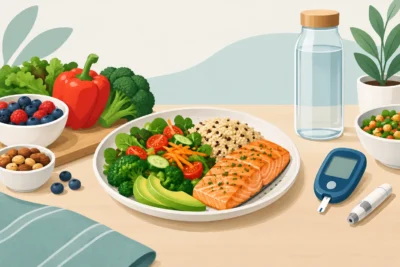
CGM vs Fingerstick Glucose Monitoring


If you have ever checked your blood sugar, seen a number that made no sense, and wondered what your body was doing the other 23 hours of the day, this question matters: cgm vs fingerstick glucose monitoring. The right choice can make blood sugar patterns easier to understand, reduce guesswork around meals, and help you take more confident action.
For many adults with Type 2 diabetes or prediabetes, this is not just a tech decision. It is a daily-life decision. You want a method that fits your budget, your routine, your comfort level, and your health goals. Some people do well with simple finger checks. Others make faster progress when they can see trends in real time.
What you\'ll find in this article?
- CGM vs fingerstick glucose monitoring: what is the difference?
- Why blood sugar patterns matter so much
- Pros of fingerstick glucose monitoring
- Pros of CGM for lifestyle-based blood sugar improvement
- Where CGM can be frustrating
- CGM vs fingerstick glucose monitoring for accuracy
- Which option is better for Type 2 diabetes or prediabetes?
- Questions to ask before you choose
- Making either method work better
CGM vs fingerstick glucose monitoring: what is the difference?
A fingerstick meter gives you a single blood sugar reading at one moment in time. You prick your finger, place a drop of blood on a test strip, and get a number. It is direct, familiar, and often less expensive up front.
A continuous glucose monitor, or CGM, uses a small sensor placed on the skin to track glucose levels throughout the day and night. Instead of isolated snapshots, it shows patterns, trend arrows, and the rise and fall of your glucose after meals, exercise, stress, and sleep.
That difference is bigger than it sounds. Fingersticks answer, “What is my glucose right now?” A CGM also helps answer, “Where is it heading, and what just caused that change?”

Why blood sugar patterns matter so much
If your goal is better metabolic health, fewer spikes, and more stable energy, patterns matter more than one random number. A fasting reading of 110 might look decent, but it does not tell you whether breakfast sends you to 180 or whether your blood sugar drops overnight.
This is where many people get stuck. They are trying to improve with food and exercise, but they cannot clearly see cause and effect. When you can connect your numbers to real habits, change becomes more practical. You stop guessing and start adjusting.
That is one reason CGMs have become so popular, even among people who are not using insulin. They can make food choices feel less abstract. You may notice that oatmeal spikes you more than eggs, or that a 15-minute walk after dinner lowers your evening readings.
Pros of fingerstick glucose monitoring
Fingerstick testing still has a valuable place. It is simple, widely available, and often covered more easily than CGM devices. For people who only need occasional checks, it can be enough.
It also gives a true blood sample at the moment you test. That matters because CGMs measure glucose in interstitial fluid, not directly in the blood, so there can be a short lag, especially when glucose is rising or falling quickly.

Another advantage is control. Some people do not want to wear a sensor all the time or deal with alerts, apps, and extra data. If you prefer a lower-tech approach and can stay consistent with testing, fingersticks may suit you well.
The main downside is obvious. You only see the times you choose to test. If you check before breakfast and before dinner, you may miss your biggest spikes completely.
Pros of CGM for lifestyle-based blood sugar improvement
For people trying to improve diabetes naturally through food, movement, sleep, and weight loss, a CGM can be a powerful teaching tool. It shows how your body responds in real life, not just in a doctor’s office.
That immediate feedback can be motivating. You eat a lower-carb lunch and watch your glucose stay steadier. You go for a walk after a meal and see the curve come down faster. Those small wins build momentum.
CGMs can also reveal hidden problems. Some people discover overnight highs, dawn phenomenon, or repeated spikes from foods they thought were healthy. Others learn that stress or poor sleep affects their readings more than expected.
For many users, this makes healthy habits stick. The number is no longer theoretical. It becomes personal and actionable.
Where CGM can be frustrating
CGMs are not perfect. Cost is one of the biggest barriers, especially if insurance coverage is limited. Sensors need to be replaced regularly, and some systems require a separate reader or compatible smartphone.
There is also a learning curve. More data is helpful, but it can become overwhelming if you check it constantly or panic over every rise. Glucose naturally moves during the day. Not every bump is a problem.
Accuracy can also vary. Compression while sleeping, sensor placement, dehydration, and rapid glucose changes can affect readings. Sometimes you may still need a fingerstick to confirm a number that seems off, especially if symptoms do not match what the sensor shows.
And then there is the mental side. For some people, wearing a sensor creates useful awareness. For others, it creates stress. If the device makes you obsess over every meal, it may not be helping as much as you hoped.
CGM vs fingerstick glucose monitoring for accuracy
This is one of the most common questions, and the honest answer is that both methods have strengths. Fingerstick meters measure blood glucose directly, but they can still vary depending on strip quality, hand cleanliness, and meter calibration. A bit of food residue on your finger can throw off a reading.
CGMs offer trend accuracy rather than just point-in-time accuracy. They are often most useful for seeing direction and patterns over hours and days. If your CGM says your glucose is rising steadily after lunch every day, that pattern is meaningful even if one exact reading is slightly different from a fingerstick.
So which is more accurate? It depends on what you mean by accurate. For one immediate blood value, fingerstick testing is often the reference point. For understanding your daily glucose story, CGM gives a fuller picture.
Which option is better for Type 2 diabetes or prediabetes?
There is no single best answer for everyone. If you have prediabetes, mild Type 2 diabetes, or are focused on lifestyle change, a CGM may help you learn faster. It can show you exactly how specific meals, snacks, and habits affect your blood sugar.
That said, you do not need a CGM to make real progress. Plenty of people improve their A1C, lose weight, and stabilize blood sugar with strategic fingerstick testing. Checking fasting glucose, plus one or two readings after meals, can still teach you a lot.
A practical middle ground works well for many people. Use a CGM for a few weeks or months to identify patterns, then switch to fingersticks if cost is an issue. Or rely mostly on fingersticks but use a CGM during periods when you are changing your diet, exercise plan, or medication.
Questions to ask before you choose
Before deciding, think about how you actually live. Are you likely to test your finger consistently? Would real-time data motivate you or stress you out? Is cost a major concern? Are you trying to identify food triggers and reduce spikes more aggressively?
Also consider your main goal. If you simply need occasional checks, fingersticks may be enough. If you want to see the impact of every meal, workout, and late-night snack, a CGM offers more insight.
There is also the issue of comfort. Some people hate finger pricks. Others dislike wearing devices. The best tool is the one you will use regularly.
Making either method work better
No matter which option you choose, the value comes from what you do with the information. Numbers alone do not improve health. Action does.
If you use fingersticks, test strategically rather than randomly. Compare before-meal and one- to two-hour after-meal readings. Keep notes on what you ate, how much you slept, and whether you exercised.
If you use a CGM, focus on trends instead of reacting emotionally to every fluctuation. Look for repeated patterns. Which breakfasts keep you stable? Which dinners cause long spikes? What happens when you walk after eating?
This is where a site like Diabetes Cure Now speaks to what many people need most: practical feedback that leads to practical change. Better food choices, consistent movement, weight loss, stress control, and sleep improvement can all shift glucose patterns in a meaningful way.
The bigger point is simple. Whether you choose CGM or fingerstick glucose monitoring, you are gathering information your body has been trying to give you all along. Use that information to build meals you tolerate better, routines you can sustain, and habits that move you toward steadier blood sugar and a healthier future.
Important notice: The content of Diabetes Cure Now is solely educational and informational and does not replace the evaluation, diagnosis, or treatment of a doctor or health professional. Before making changes to your diet, exercise, or medication, consult with a qualified professional..
Content reviewed for educational purposes and based on public medical sources.
Sources consulted
- American Diabetes Association (ADA)
- Mayo Clinic
- CDC
- NIH
12 Diabetic Recipes That Keep Meals Balanced
Diabetic Kidney Health Guide for Daily Protection
How to Start Walking With Diabetes Safely
10 Healthy Soups for Diabetics That Satisfy
Do Chia Seeds for Blood Sugar Really Help?

How to Reduce Dawn Phenomenon Naturally
Is Fruit Safe for Diabetes? What to Know
How to Walk After Meals for Better Blood Sugar